
Showing 25–33 of 33 results
End of content
End of content
Explore a range of spill kits designed for spill containment and clean-up in industrial workplaces. Choose from general purpose spill kits, oil and fuel, hazchem and marine spill kits, available in sizes from 40L to 770L. Each kit includes absorbents, PPE and disposal materials to help manage spills in workshops, warehouses, transport operations and other sites handling hazardous liquids.
Showing 25–33 of 33 results


End of content
End of content
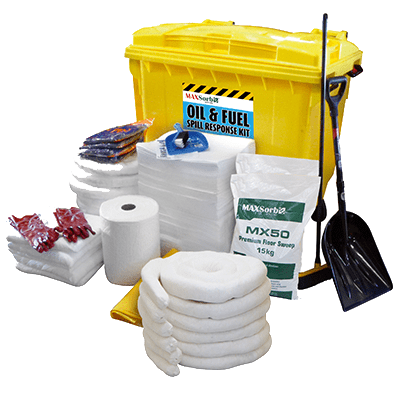
Spill kits are pre-assembled response packages. Absorbent pads, minibooms and floorsweep soak up and contain the liquid, PPE protects whoever is cleaning it up, and labelled disposal bags hold the waste until it can be removed properly. Keeping those items together in one labelled container is the difference between a contained spill and one that spreads while someone goes looking for gloves.
Choosing between general purpose spill kits, oil spill kits and chemical spill kits comes down to what is stored or handled nearby. General purpose kits use absorbents that take up water, coolant, oil and most non-aggressive liquids, which suits workshops and warehouses carrying a mixed inventory. Oil and fuel kits use hydrophobic absorbents that take up hydrocarbons while repelling water, so they keep working on wet ground, on a hardstand after rain and on water itself. A hazchem spill kit uses absorbents selected for aggressive chemicals, supplied with elbow-length PVC gloves for the responder. Marine kits are built around floating booms and hydrophobic absorbents for spills on water.
Sizing is driven by the largest credible spill at that location rather than the total volume held across the site. A 40L kit handles drips and small decanting spills at a single point of use. 80L and 120L kits cover a drum store or a small bunded area. 240L and larger kits in wheelie bins suit bulk storage, IBC compounds and fuel bowsers, where a failed valve or a dropped container releases a far greater volume. Position kits where spills actually happen rather than at a central store, and bring them back to full from refill kits and loose absorbents after any use. Confirm the spill control arrangements you put in place meet the requirements that apply to your site and the class of liquid being stored.
A spill kit is a pre-assembled package of absorbents, PPE and disposal materials kept ready for a spill. Everything needed to contain and clean up is held in one labelled container, so response does not depend on finding items separately.
Match the kit to the liquid. General purpose suits water, coolant, oil and most non-aggressive liquids. Oil and fuel suits hydrocarbons, including on wet ground. Hazchem suits aggressive chemicals such as acids and alkalis.
Typical spill kit contents are absorbent pads, minibooms, granular floorsweep, elbow-length PVC gloves, labelled disposal bags, and an instruction sheet with a reorder form. Kits from 80L add a brush and pan set, and the 770L oil and fuel kit adds a broom and a spark-proof shovel.
Regulation 357 of the WHS Regulations requires a spill containment system wherever there is a risk of a hazardous chemical spill or leak, so far as is reasonably practicable. That system must also provide for clean-up and disposal, which is the part a spill kit covers. Victoria operates under separate OHS laws, so check what applies to your site.
Capacity and format. A 40L is a carry bag with one miniboom and 20 pads for a single point of use. A 240L is a labelled wheelie bin with seven minibooms and 100 pads, sited at a bulk store and wheeled to the spill.
Where aggressive chemicals are stored or handled, including acids and alkalis. Hazchem kits use absorbents selected for those products, which general purpose kits are not.
Size against the largest credible spill at that location, not the total held on site. A single decanting point may only need 40L, while an IBC compound or bulk fuel store warrants 240L or larger.
Close to where a spill is likely, not in a central store across the yard. Kits at the decanting point, the drum store and the bowser get used. A kit that takes five minutes to reach often does not.
Check after every use and on a routine schedule in between. Confirm the contents match the list, that nothing has been borrowed, and that PPE and bags are still serviceable. A kit that has been raided is not a kit.
Yes. Refill kits restore the absorbent contents without replacing the bin or bag, which is the usual way to bring a used kit back to full. Loose pads, booms and floorsweep can also be bought separately.
Used absorbents hold the liquid they have soaked up, so they carry the hazard of the product. They need bagging, labelling and disposal in line with the requirements for that class of liquid at your location.
The absorbents themselves do not expire in normal storage, though PPE and bags can degrade with age, heat and sunlight. Store kits out of direct sun and replace anything perished during routine checks.
No products in the cart.
To provide the best experiences, we use technologies like cookies to store and/or access device information. Consenting to these technologies will allow us to process data such as browsing behaviour or unique IDs on this site. Not consenting or withdrawing consent, may adversely affect certain features and functions.
Join our mailing list to receive the latest updates, exclusive offers, and news straight to your inbox. Don’t miss out!
We respect your privacy. Unsubscribe anytime.